Thursday, March 19, 2020

Fw: (LML) the Maltalep study- Harm after SDR prophylaxis


Leprosy Mailing List – March 19,  2020


Ref.: (LML)  the Maltalep study- Harm after SDR prophylaxis


From:  Annemiek Geluk, Leiden, the Netherlands


Dear Pieter,


In the International Journal of Infectious Diseases (IJID) we have previously replied to the Letter to the Editor by Diana Lockwood, Barbara de Barros and Steve Walker (see attached)


The MALTALEP trial conducted in Bangladesh investigated the possibility to increase the protective effect of BCG (re)-vaccination among contacts with SDR. This combined intervention makes it unsuitable to directly compare with the results of the COLEP trial that was conducted over 10 years ago and studied the protective effect of SDR only. We have explained that in our reply to the editor of IJID. 


The conclusion of Lockwood et al. about the harmful effect of SDR in general cannot be based on the results of the MALTALEP trial.


Kind regards,


         Annemieke


Prof. dr. A. Geluk – Dept. Infectious Disease – LUMC

Immunodiagnostics of Leprosy & Tuberculosis

https://www.universiteitleiden.nl/medewerkers/annemieke-geluk 


LML - S Deepak, B Naafs, S Noto and P Schreuder

LML blog link: http://leprosymailinglist.blogspot.it/

Contact: Dr Pieter Schreuder << editorlml@gmail.com

--
You received this message because you are subscribed to the Google Groups "Leprosy Mailing List" group.
To unsubscribe from this group and stop receiving emails from it, send an email to leprosymailinglist+unsubscribe@googlegroups.com.
To view this discussion on the web, visit https://groups.google.com/d/msgid/leprosymailinglist/0e384dee-9913-40dc-b0a3-b341356cf4ec%40googlegroups.com.

Fw: (LML) the Maltalep study- Harm after SDR prophylaxis


Leprosy Mailing List – March 19,  2020

Ref.: (LML)  the Maltalep study- Harm after SDR prophylaxis

From:  Diana Lockwood, Barbara de Barros and Steve Walker, London


Dear Pieter,


We discussed the increase in MB leprosy cases that occurred in a trial of single dose Rifampicin (SDR) and BCG, the MALTALEP trial on the LML in Oct 2019.   This trial shows no significant protection against leprosy by SDR.


We have now published our comments as a letter in International Journal of Infectious Diseases 2020. We attach the link to the paper. https://doi.org/10.1016/j.ijid.2020.01.054


Since there is now evidence of harm in giving SDR as prophylaxis against leprosy we suggest that there should be further discussions about the use of this intervention.


Diana Lockwood

Barbara de Barros

Steve Walker


Clinical Research Department, London School of Hygiene & Tropical Medicine, London UK


LML - S Deepak, B Naafs, S Noto and P Schreuder

LML blog link: http://leprosymailinglist.blogspot.it/

Contact: Dr Pieter Schreuder << editorlml@gmail.com

--
You received this message because you are subscribed to the Google Groups "Leprosy Mailing List" group.
To unsubscribe from this group and stop receiving emails from it, send an email to leprosymailinglist+unsubscribe@googlegroups.com.
To view this discussion on the web, visit https://groups.google.com/d/msgid/leprosymailinglist/82532e26-e82f-44bd-a897-db78f5b95688%40googlegroups.com.

Tuesday, March 17, 2020

Fw: (LML) Clofazimine supplies?


Leprosy Mailing List – March 17,  2020

Ref.:    (LML) Clofazimine supplies?

From:  Ben Naafs, Munnekeburen, the Netherlands


Dear Pieter,


When I was still practising in the Netherlands, I requested the WHO for a supply and always got Clofazimine as separate capsules. At present in Tanzania we are using Clofazimine out of blister packs. This must be of course a temporary solution only.


Pressure of the leprosy community on WHO seems to result in small changes. Otherwise it may be possible to use the press. But in my experience, they are not always that bureaucratic.


Regards,


Ben


LML - S Deepak, B Naafs, S Noto and P Schreuder

LML blog link: http://leprosymailinglist.blogspot.it/

Contact: Dr Pieter Schreuder << editorlml@gmail.com

--
You received this message because you are subscribed to the Google Groups "Leprosy Mailing List" group.
To unsubscribe from this group and stop receiving emails from it, send an email to leprosymailinglist+unsubscribe@googlegroups.com.
To view this discussion on the web, visit https://groups.google.com/d/msgid/leprosymailinglist/edba0280-d901-4e4e-aa72-c3cbad1643a9%40googlegroups.com.

Fw: (LML) Clofazimine supplies?


Leprosy Mailing List – March 17,  2020

Ref.:    (LML) Clofazimine supplies?

From:  C. Ruth Butlin, London, UK


Dear Pieter,


In February, when I was in India, I heard that it has been almost impossible for several months, to obtain supplies of loose clofazimine there.


"Hansepran" (clofazimine manufactured and distributed by Abbott) apparently can no longer be purchased in the open market. I understand that production has been temporarily stopped. "Lamprene" (clofazimine from Novartis) is no longer commercially available, according to the Novartis website. Presumably it is still being manufactured for the Multidrug therapy blister calendar packs distributed through the kind auspices of WHO.


Have other LML readers encountered this problem?


Can anyone verify if in fact there is a genuine shortage of clofazimine?


Since projects in other neighbouring countries have relied on buying clofazimine imported from India, the impact of a shortage there is of international concern.


Does anyone know where or how one can now buy loose clofazimine for treatment/prevention of ENL reaction?


Perhaps there are manufacturers in China or Brazil or elsewhere still making clofazimine for sale for use in managing ENL reaction?


In the event of a clofazimine shortage, one would hope that the scarce resources of this valuable drug would not be allocated for PB patients to receive triple therapy (with reference to the WHO's recent conditional recommendation to consider triple therapy -with rifampicin, dapsone and clofazimine- for 6months as standard chemotherapy for all new PB cases)!


Yours faithfully, C Ruth Butlin


LML - S Deepak, B Naafs, S Noto and P Schreuder

LML blog link: http://leprosymailinglist.blogspot.it/

Contact: Dr Pieter Schreuder << editorlml@gmail.com

--
You received this message because you are subscribed to the Google Groups "Leprosy Mailing List" group.
To unsubscribe from this group and stop receiving emails from it, send an email to leprosymailinglist+unsubscribe@googlegroups.com.
To view this discussion on the web, visit https://groups.google.com/d/msgid/leprosymailinglist/42174230-c6a5-4e9b-818d-8cbbd9b61bbc%40googlegroups.com.

Sunday, March 15, 2020

Fw: (LML) The "reproductive numbers" in COVID-19 and HD


Leprosy Mailing List – March 15,  2020

Ref.:    (LML) The "reproductive numbers" in COVID-19 and HD

From:  Joel Almeida, Mumbai, India


Dear Pieter and colleagues,


The COVID-19 pandemic has highlighted a key parameter: R(0), the "reproductive number". (1) How many new infections does a single infection produce? This allows an estimate of the maximum number of people likely to be infected in a human population: 

1-1/R(0). In COVID-19, given an estimated R(0) of 2.5, the likely maximum fraction of the population that eventually will become infected is 60%. If the true R(0) is higher, the maximum fraction will also be higher. Control measures tend to reduce R(0). So does immunity develop by sub-clinical infection.


The "reproductive number" is useful in understanding the epidemiology of transmission in HD (Hansen's disease) too. 


In HD there is a huge difference in the number of bacilli shed/day by persons with LL disease compared to persons with even BL and BT forms. Persons with untreated LL disease can shed tens of millions of viable bacilli per day, whereas others shed several orders of magnitude fewer, and sometimes even no bacilli. (2) One untreated person with LL disease is therefore equivalent to millions of untreated persons with other types of HD. Therefore, the parameter of greatest epidemiological consequence is the reproductive number of LL disease. 


We can work backwards from the maximum observed fraction of the population with LL disease (cumulative incidence) to estimate the R(0) of HD in hyper-endemic areas, in the presence of limited-duration MDT.


Given an average age of acquiring LL HD about 35 years

average remaining life expectancy 40 years 

incidence rate of all types of HD in endemic areas under 5 in 10,000 population/yr

fraction of LL HD among all newly diagnosed patients 1%


We get a cumulative incidence of LL HD in the region of 2 in 10,000 population.


The reproductive number R(0) of LL HD in hyperendemic areas using limited-duration MDT can therefore be estimated as 1.0002. 


That is, one person with LL HD produces roughly one new person with LL HD. The bacilli seem to be clinging on precariously to the human population. This suggests that interruption of transmission is nearer at hand than sometimes believed. This is in areas without armadillos.


However, in families with a concentration of LLp genomes, the R(0) of LL HD is likely to be much higher than 1.0002. One person with LLp disease can give rise to several new persons with LLp disease, as is observable in multiple-patient households. The fraction of the children in such a family developing LLp disease can be as high as 100%. 


HD therefore appears to be an infectious disease that is self-limiting in human populations, but can flare up in families with offspring who have a concentration of the LLp genome. This gives rise to strong clustering around persons with LL disease (households, workplaces etc), and around families with multiple persons developing LL disease.


All this has practical implications for interrupting transmission. Our focus in interrupting transmission needs to be on reducing the R(0) of LL HD to less than one. That will spell the end of HD transmission. What should we do?


1. Ensure that a person with LL disease never again is neglected during their lifetime. Ensure that bacilli can never regain a foothold in such a person. This is not only for their protection from damage cause by bacilli, and to uphold their human dignity and rights, but also to help reduce the R(0) of LL HD in the population to less than one. Signs of recurrence can be masked by sequelae of past active infection, delaying the diagnosis of recurrence. Prolonged anti-microbial protection for all LL HD patients is therefore the safest approach, for their own benefit and the benefit of the whole population.


2. Ensure that drug resistance is delayed. Drug-resistance can multiply the R(0) of LL HD. Avoid the use of single drugs for treatment or prophylaxis. Persons with undiagnosed LL HD who are given a single dose of rifampicin can play a disproportionately important role in the selection and transmission of drug-resistant HD bacilli. Selecting drug-resistant mutant bacilli could maintain the R(0) above one and allow the bacilli to continue spreading for generations despite all our other efforts.


3. Ensure prompt diagnosis of HD, especially LLp (de novo LL) HD. This is easily excluded by the use of skin smears, or serology and PCR. However, the clinical signs can often be so subtle that even experienced clinicians miss the early signs. Reliable skin smears need to be restored especially in endemic areas, supplemented by more sensitive tests whenever possible.


HD appears to be a disease that is maintained precariously in human populations (outside the Americas, where armadillos live) by human errors. We can keep correcting our errors, take effective action, and confidently look forward to interrupting transmission.


Joel Almeida


References


1. Anderson RM, Hesterbeek H, Klinkenberg D, Hollingsworth TD. How will country-based mitigation measures influence the course of the COVID-19 epidemic? Lancet.com. Published Online March 6, 2020 https://doi.org/10.1016/S0140-6736(20)30567-5


2. Davey TF, Rees RJ. The nasal dicharge in leprosy: clinical and bacteriological aspects. Lepr Rev. 1974 Jun;45(2):121-34.  


LML - S Deepak, B Naafs, S Noto and P Schreuder

LML blog link: http://leprosymailinglist.blogspot.it/

Contact: Dr Pieter Schreuder << editorlml@gmail.com

--
You received this message because you are subscribed to the Google Groups "Leprosy Mailing List" group.
To unsubscribe from this group and stop receiving emails from it, send an email to leprosymailinglist+unsubscribe@googlegroups.com.
To view this discussion on the web, visit https://groups.google.com/d/msgid/leprosymailinglist/b3a58bae-3bad-46df-80cc-5db9195a2a34%40googlegroups.com.

Friday, March 13, 2020

Fw: (LML) SDR-PEP and the risk of MB HD

Leprosy Mailing List – March 13,  2020

Ref.:  (LML) SDR-PEP and the risk of MB HD

From:  Joe Almeida, London and Mumbai


Dear Pieter and colleagues,


Thanks to Khorshed Alam for his thoughtful comments on the review of SDR-PEP and the risk of MB HD (LML 5 March 2020). Does objective evidence bear out his views? LML enables such rapid, open discussion through which we can advance our understanding and boost our chances of permanently defeating the bacilli. 


The review had agreed with Khorshed Alam's view that an exemplary HD (Hansen's disease) control programme has long been run in this part of Bangladesh. Household contacts, especially of infectious patients, are known to have a much higher risk of HD than other persons. In this rural health programme, all household contacts of newly diagnosed patients have been routinely examined since at least 1995. This was not a recently introduced feature. Household contact examination has long been intensive and prolonged (during years 0-2 following diagnosis in households with a new PB patient and years 0-5 in those with new MB patient). (1) This cannot explain the demonstrable retardation in the decline of HD in these 4 districts after 2010. 


The sheer magnitude of the incidence rate, too, cannot explain the said retardation after 2010, because this magnitude was much greater in earlier years.


The overall intensity of active case-finding in the total population is indicated by objective evidence. As the frequency of active case finding increases, the total new patient detection rate increases. However, the proportion of MB HD among newly detected HD patients simultaneously decreases. This is because many single-lesion PB and other self-limiting forms of HD are revealed by more frequent active case-finding. 


Figure 1. (based on ref 2) There is demonstrable inverse relationship between the intensity of active case-finding and the proportion MB among newly detected HD patients. For every 10% increase in the proportion of new patients detected by active case-finding, a 7.5% decrease was observed in the proportion of MB HD among newly detected cases


In this area of Bangladesh, the proportion of MB HD was reported to increase across 2010 and beyond. (3) This indicates a decrease in the overall intensity of active case-finding across the population. This tends to produce a fall in the number of new patients detected/yr, and cannot readily explain the levelling-off observed.


SDR-PEP was given to a substantial proportion of contacts of all newly detected MB HD patients in these 4 districts of Bangladesh in the MALTALEP trial. A population of 8 million with a new case detection rate of about 1 in 10,000/year including an MB proportion of about 25% is expected to yield only about 200 new MB patients/year. The MALTALEP trial included the contacts of 475 index MB patients. 7039 contacts received SDR-PEP, and 14988 contacts in total were included for BCG (re)vaccination. BCG alone was demonstrated to have some protective effect against all forms of HD by comparison to historical placebo-treated controls in this area, plus a strongly protective effect is demonstrable against MB HD. Despite this, SDR-PEP seemed to erase any favourable epidemiological impact at population level.
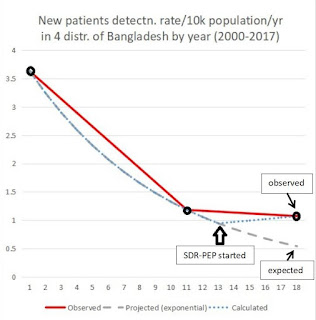


Figure 2. SDR-PEP produced no favourable epidemiological impact in the MALTALEP trial area, and may even have contributed to the retardation of the earlier decline.


In areas with less accomplished expertise, facilities, and operational capacity, the epidemiological impact of SDR-PEP is likely to be even less favourable. Such unfavourable impact is striking in itself, even if the risk of selecting drug-resistant mutant bacilli is ignored. 


The risk of selecting drug-resistant mutants is brought on by the use of a single drug (rifampicin) instead of multi-drug chemoprophylaxis. The risk of selecting drug-resistant mutants is highest among missed LL patients in programmes that lack clinical expertise, skin smears, serology etc.. LL patients with few or no physical signs of disease are then liable to be misclassified as healthy contacts and given SDR-PEP. That is a recipe for the selection of drug-resistant bacilli. Even experienced clinicians have been known sometimes to miss the often subtle physical signs of early LL disease, when tens of millions of viable bacilli per day are still shed. (4) Minimally trained staff are almost certain to make this mistake.


Nevertheless, this is an exciting time in the history of public health because we can achieve near-zero transmission of HD once we focus on emulating success. A rapid decline of HD (17% to 20%/yr) was already demonstrated in Shandong and Uele at a time when they had a relatively low GDP per capita, as discussed here previously. Similar success can be spread across the globe. We are like detectives working out how the vicious criminals (the bacilli) operate and what impact is demonstrable from our efforts. We can keep discarding what does not work, expanding and improving what works.


Discussion of the example protocol for safe interruption of transmission indicated why HD continues to spread, and what we need to do in order to achieve zero transmission. Previously treated LLp patients with covert recurrent disease probably play an important role in Bangladesh, as they demonstrably do elsewhere.(5) They serve as enduring sources of concentrated viable bacilli. Past sequelae tend to disguise the recurrence of disease in such patients. The risk of new HD among their contacts remains high for years. Prolonged anti-microbial protection for LL patients, such as by post-MDT chemoprophylaxis with 3 bactericidal drugs, can not only protect the individual patient but also switch off this important source of concentrated viable bacilli. Esteemed colleagues, armed with the most helpful technology, can improve such example protocols and adapt them to their own areas. This might yield an even more rapid decline in HD than the 20%/yr achieved in Shandong and Uele.   


Instead of HD being considered too trivial a problem to deserve attention, it can become a triumph of science-based intervention for zero transmission. Zero transmission is demonstrably within reach everywhere, except perhaps in the Americas where armadillos can maintain transmission. No child should develop HD. That is our shared dream, and it is demonstrably achievable. As we keep helping one another to spot critical clues and to focus on what works, we boost our chances of success. Drug resistance is the most important threat to our success, and the use of single drugs (eg., SDR-PEP) is the surest way to increase this threat. We know from the experience in TB that mathematical models are useless in the face of drug-resistance because drug-resistance is a discontinuity. It is more like falling off a cliff than gently sliding down a hillside.


Best wishes to Khorshed Alam and all who are working on HD. We are working together to save human nerves, limbs, eyes, minds, livelihoods, rights and relationships. We cannot afford to overlook clues, nor to fail, nor to leave our children a legacy of drug resistance and continued transmission of HD. Shandong succeeded. So can we, if we keep steering away from demonstrable failure and emulate demonstrable success instead


Joel Almeida


References


1. Butlin CR, Nicholls P, Bowers B et al. Household contact examinations: outcome of routine surveillance of cohorts in Bangladesh. Lepr Rev (2019) 90, 290–304

2. Xiang-Sheng Chen, Wen-Zhong Li, Cheng Jiang, & Gan-Yun Ye. Leprosy in China: epidemiological trends between 1949 and 1998. Bulletin of the World Health Organization, 2001, 79: 306–312

3. Butlin CR, Nicholls P, Bowers B et al.Outcome of late healthy household contact examinations in leprosy-affected households in BangladeshLepr Rev (2019) 90, 305 – 320

4. Davey TF, Rees RJ. The nasal dicharge in leprosy: clinical and bacteriological aspects. Lepr Rev. 1974 Jun;45(2):121-34.

5. Rao PS, Mozhi NM, Thomas MV. Leprosy affected beggars as a hidden source for transmission of leprosy. Indian J Med Res. 2000 Aug;112:52-5.


LML - S Deepak, B Naafs, S Noto and P Schreuder

LML blog link: http://leprosymailinglist.blogspot.it/

Contact: Dr Pieter Schreuder << editorlml@gmail.com

--
You received this message because you are subscribed to the Google Groups "Leprosy Mailing List" group.
To unsubscribe from this group and stop receiving emails from it, send an email to leprosymailinglist+unsubscribe@googlegroups.com.
To view this discussion on the web, visit https://groups.google.com/d/msgid/leprosymailinglist/ff8a8d5b-7a4d-471a-99b9-2178146edc1e%40googlegroups.com.

Thursday, March 12, 2020

Fw: (LML) On terminology: exploring the way forward


Leprosy Mailing List – March 12,  2020

Ref.:    (LML) On terminology: exploring the way forward

From:  Alice Cruz, Quito, Ecuator


Dear friends,

I am sharing mine and Professor Patricia Deps' contribution to the ongoing, exciting and controversial discussion on how to dignify the language we use for the disease and for the persons who have experienced it or are still living with it. We sincerely hope that together we can find emancipatory and dignified terminology. We also believe that none terminology can be truly emancipatory if it does not reflect the voice and choice of persons who have personally experienced the disease or continue to live with it and its related social consequences and impact.

https://www.thelancet.com/journals/laninf/article/PIIS1473-3099(20)30061-X/fulltext

With best regards,

Alice

(Note editor: we can only present you the abstract; the Lancet does not allow us to transfer the complete article without payment). 


Queridos amig@s,


Partilho uma contribuição minha e da Professora Patricia Deps para a estimulante e controversa discussão em curso sobre como dignificar a linguagem que usamos para a doença e para as pessoas que a experienciaram ou que ainda vivem com ela. Esperamos sinceramente que, junt@s, possamos encontrar terminologia emanicpatória e dignificante. Também acreditamos que nenhuma terminologia pode ser verdadeiramente emancipatória se não reflectir a voz e a escolha das pessoas que experienciaram pessoalmente a doença ou continuam a viver com ela e o seu impacto e consequências.

https://www.thelancet.com/journals/laninf/article/PIIS1473-3099(20)30061-X/fulltext

Atentamente,

Alice


LML - S Deepak, B Naafs, S Noto and P Schreuder

LML blog link: http://leprosymailinglist.blogspot.it/

Contact: Dr Pieter Schreuder << editorlml@gmail.com

--
You received this message because you are subscribed to the Google Groups "Leprosy Mailing List" group.
To unsubscribe from this group and stop receiving emails from it, send an email to leprosymailinglist+unsubscribe@googlegroups.com.
To view this discussion on the web, visit https://groups.google.com/d/msgid/leprosymailinglist/c19a0162-960c-4c03-a2c1-73f5a4facab3%40googlegroups.com.